Bette Ann Do I Know You Summary
W hen Anne Tyler's United kingdom of great britain and northern ireland tour for her latest novel became an early victim of the coronavirus, and her publisher announced that the 78-twelvemonth-old would exist conducting all media interviews by phone from the safety of her home in Baltimore, Tyler felt some relief, but mainly she felt guilt. She is ane of the world's nigh acclaimed modern novelists, winner of both a Pulitzer (for Animate Lessons, 1988) and the National Volume Critics Circle laurels (for The Adventitious Tourist, 1995, which was turned into an Oscar-winning picture) and a finalist for the Man Booker (A Spool of Blue Thread, 2015) and the Women'due south prize for fiction (Ladder of Years from 1995, and A Spool of Bluish Thread). But until 2012, she maintained a silence as assiduous as that of Thomas Pynchon or JD Salinger. She never liked – and still doesn't, just needs must in today's earth – talking about how she does what she does, because that leads to self-consciousness, which is never good for creativity.
Then she was "kind of relieved" when the bout was cancelled. "But I remember I used to pray the school would burn down down before a math examination the side by side day. Yet if it had actually burned down I would take felt and then guilty. Then at present I'1000 thinking, 'Oh dear, be careful what you wish for!'" she says.
Phone interviews are generally frustrating, a mess of missed connections and awkward interruptions. But Tyler has a fashion that is as open and engaging as her prose, her conversation punctuated by charming anachronisms such as "bestir" and "alas", and it soon feels as if I know her every bit well as I know her brilliantly drawn characters. As I, too, am at present working from home I kickoff by apologising for the background noise of children and dogs. "Oh I dearest to hear children and dogs! That sounds good to me. I beloved normal life," she says.
For the past one-half-century, Tyler has been the pre-eminent novelist of normal life. She is famously proficient at summing up a character in a precise line ("She had not grown fuller or softer with age. She was like certain supermarket vegetables that turn from green to withered without ever ripening" – from Dinner at the Homesick Restaurant, 1982), only twice she tells me she is "no good at plot, as I'm sure you've noticed". It's true that no i would mistake aTyler novel for a John Grisham, just no one can friction match her evocation of the moments that build up a life: the bad-mannered family meals, the day your spouse suddenly seems like a stranger, trying to make sense of how yous have become the developed yous are today, the conflicted gestures we make at trying to exist skilful. "Time passing is a plot. You can't not have something happen if the years go by," she says.
As a kid, Tyler's favourite book was the American classic The Piddling House by Virginia Lee Burton, about a house watching a city sprout up effectually it. Her fans – who have ranged from John Updike to Jacqueline Wilson to Nick Hornby – will recognise her memory of hoping the school would burn as classic Tyler: her novels are studded with adult characters evoking babyhood sensations, pleating time, revealing the truth of the developed through the child they were. In 2018'south Clock Dance, a widow compares recovering from grief to "rainy days in her childhood when she would resign herself to staying in, reading or watching daytime TV, and then in the afternoon the sunday would suspension through unexpectedly and she would think, Oh. I judge I tin become outside now. Isn't that … a practiced thing, I guess." In The Accidental Tourist, Macon Leary empathetically imagines his immature son Ethan's final moments before he was killed in a tearing law-breaking: "meekly moving to the kitchen with the others, placing his hands flat against the wall equally he was ordered and no dubiousness bouncing slightly on the balls of his anxiety".
"I'm more in touch with my emotions and the visceral sensory from childhood than whatsoever other part of life. I don't know if information technology helps with inventiveness, but I do know that when I talk to other writers they talk about their babyhood in great detail," Tyler says. (She also still has residues of that childlike belief that ane tin brand something happen by thinking about it. Just every bit she used to worry she would cause the school to burn down down through wishing it, when I ask how she could bear to write the scene of Ethan's murder in The Accidental Tourist, she says she deliberately made him younger than her ii daughters were so, "and then I wouldn't think as they came upwardly to that historic period, 'Oh no, what have I set up in motion?'")
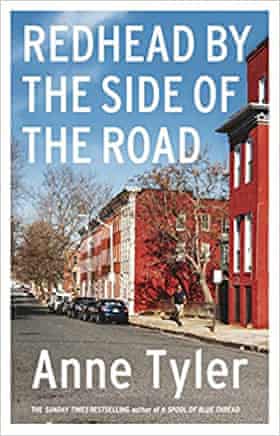
Her new novel, Redhead by the Side of the Route, her 23rd, features many of the usual Tyler tropes. Its protagonist, Micah, is a homo, as and so many of Tyler's greatest characters are, which is partly why she has then many male fans. Writing in this paper in 2012, Mark Lawson put her cross-gender appeal downwards to the mode "she deals sympathetically and redemptively with male fecklessness and helplessness". Tyler grew up with three brothers and was happily married for 34 years to Taghi Mohammad Modarressi, an Iranian psychiatrist, until his death in 1997. "I am very comfortable writing as a human, and I think that's considering I had really proficient men in my life. They made me experience comfortable and I thought, 'OK, they're not so unlike from me,'" she says.
Like many of Tyler's male characters – Ian in Saint Maybe, Barnaby in A Patchwork Planet, Jesse in Breathing Lessons, Ezra in Dinner at the Homesick Eating place – Micah has permit his life migrate past him after a youthful regret. Like Macon in The Accidental Tourist, he tries to counter the loss of control over his life by adhering to cocky-coined rules near when he cleans the kitchen, how he makes the bed, how he drives. "Micah" even sounds similar "Macon", only when I inquire Tyler if the echo was deliberate she says no. "But I do often have fantasies well-nigh my characters catastrophe up in the aforementioned picayune part of boondocks and running into i another, so I can film Micah and Macon doing that."
Like all of Tyler'due south characters, Micah lives in Baltimore, as Tyler herself has done for more than than 50 years. She has said that she's a writer so she tin can live out dissimilar lives, but it seems that whatever life she imagines, she always wants to live in Baltimore. "Yes, that's probably true. It'southward a city with grapheme, but it is likewise laziness on my part – by setting the book here I don't have to do much inquiry," she says with easy self-deprecation. I cannot permit that laissez passer: her books are full of meticulous research, such equally the accurate period details in her decades-spanning family sagas, The Amateur Marriage and A Spool of Blue Thread. She meticulously writes her books out in longhand multiple times, and and so reads them into a recorder and listens back to make sure the dialogue suits each character and there are no clangers. The thought that Tyler defaults to anything in her books out of laziness is nonsense – she only loves her city.
"It'due south true, I exercise love it," she says. "It'south funny, it was a full accident that I came to the city, information technology was only for my husband's job. For the first two years we were saying, 'We made a mistake, let's go back.' But so you sink in, little by little."
Unlike her other novels, Redhead by the Side of the Road features multiple references to electric current events. Micah avoids watching the news because information technology's besides "depressing", but he can't block out the "unspeakably lamentable" bulletins from his clock radio: "a mass shooting in a synagogue; whole families are dying in Republic of yemen; immigrant children torn from their parents volition never, always be the same, fifty-fifty if past some unlikely chance they are reunited tomorrow."
"I was writing the book already by the time Trump was in office and all that was going on. And then I consciously felt it would be immoral to pretend life was just la la la. I don't want to be one of those people who ties their novel to current events so it'southward practically out of a paper, but at the same time I felt I should mention that information technology is an unhappy time," she says. Her books ofttimes terminate optimistically, showing human kindness. Merely is she having trouble maintaining that optimism about humanity in the current political climate? She hesitates for a second. "Not up close, if y'all know what I hateful. Up close you'll always see things to exist optimistic virtually."
Tyler grew up in Quaker communities effectually the due south and midwest, the eldest of four children. She did not nourish mainstream school until she was xi, and a common theme in her books is a grapheme looking at the "normal" earth and trying to understand how it works, such as Micah feeling bewildered by the happy couples he sees on his morning time jogs, or Aaron flummoxed by marriage in The Beginner's Goodbye: "It seemed nosotros just never quite got the hang of being a couple the fashion other people did. We should have taken lessons or something; that's what I tell myself."
"One of the start things that happened when I joined the schoolhouse was I was surrounded by these girls and they were asking me all these questions. Ane said, 'Do you have a boyfriend?' And I said, 'Oh, I'yard only 11.' And she said, 'I know, do you accept a boyfriend?' And I thought, 'Oh, I'm in another world here.' Information technology was very tough to figure out, and I call up it very clearly," Tyler says. While at university, she started to write brusque stories, and then published her showtime novel, The Tin Can Tree, when she was 23. Aside from a five-year break to enhance her daughters, she has written steadily ever since.
"I know the world does not need another book from me, but I have nothing else to do with myself. I have no hobbies. And so then I experience guilty when I say to my amanuensis, 'I seem to have another book ready if you desire to take a look at it …'" she says. Her platonic day would involve several hours of "good involved writing, the kind when y'all suddenly await upward and iii hours have gone past".
While liking Tyler's books is equally uncontroversial as liking chocolate, in that location have been some criticisms over the years, some more fair than others. Those who dismiss her every bit sentimental ("our foremost NutraSweet novelist", 1 American critic wrote) overlook the bitter humour in her work. "Repetitive" is more merited, although the familiar plots are shells for her elegant writing and characterisation, which are never boring. Yet I've plant some of her more than recent novels less satisfying than her mid-career summit of Dinner at the Homesick Restaurant, The Accidental Tourist and Breathing Lessons. The New York Times' former book critic Michiko Kakutani put it more than strongly in 2012 when she complained that instead of the "intimate knowledge of her characters' inner lives" we get in Tyler'due south earlier books, the characters in The Beginner's Goodbye are "irritating stick figures".
But Tyler is her ain best critic. She recently reread The Accidental Tourist for the showtime time in many years. "And ane of the things I thought was, 'I recall I was a better writer when I was younger.'" What made her remember that? "I was more detailed, I took more time. It's non as if I'm in a blitz at present, only I trust the reader more. I don't feel like I have to say that much about the character's inner feelings. Just and so every bit I read The Accidental Tourist I thought, 'Well, information technology's kind of nice to see all of Macon's inner feelings there.'" Aptly for a writer who always sees the best in her characters, Tyler's mistake was perhaps trusting some of her readers as well much.
Her daughters live in Philadelphia and San Francisco, and Tyler knows she has a tendency towards self-isolation, whether in that location's a global pandemic or non, "and I don't think that's always healthy". And so "to bring the world into me", she has – when life is normal – regular nights at her home with friends, including a weekly friendship group she calls "Wine Therapy". She is already working on her next book, "and once again, it's about a family unit and set up in Baltimore", she says in a tone of pure self-mockery. So with the grace that comes from a lifetime of cocky-knowledge, sinking in petty by little, she adds, "And I love all that."
-
Redhead past the Side of the Road is published by Chatto.
Source: https://www.theguardian.com/books/2020/apr/11/anne-tyler-up-close-youll-always-see-things-to-be-optimistic-about
0 Response to "Bette Ann Do I Know You Summary"
Postar um comentário