What Was the Last State to Abolish Slavery

An animation showing the gratis/slave condition of U.S. states and territories, 1789–1861 (see carve up yearly maps below). The American Ceremonious War began in 1861. The 13th Amendment, effective December 1865, abolished slavery in the U.S.
In the U.s.a. before 1865, a slave land was a country in which slavery and the slave trade were legal, while a free state was one in which they were not. Between 1812 and 1850, it was considered by the slave states to be politically imperative that the number of free states not exceed the number of slave states, and so new states were admitted in slave–costless pairs. There were, nonetheless, some slaves in most free states upwardly to the 1840 census, and the Fugitive Slave Human action of 1850 specifically stated that a slave did not get complimentary by entering a gratis land.
Although Native Americans had pocket-size-calibration slavery, slavery in what would become the U.s. was established as part of European colonization. By the 18th century, slavery was legal throughout the Thirteen Colonies, after which rebel colonies started to cancel the practice. Pennsylvania abolished slavery in 1780, and about half u.s.a. abolished slavery past the finish of the Revolutionary War or in the first decades of the new country, although this did not usually mean that existing slaves became complimentary. Although not 1 of the 13 Colonies, Vermont declared its independence from United kingdom of great britain and northern ireland in 1777 and at the same time express slavery, before being admitted equally a state in 1791.
Slavery was a very divisive effect in the United States. Information technology was the largest outcome during the writing of the U.Southward. Constitution in 1787, and was the chief cause of the American Ceremonious War in 1861. Only before the Civil State of war, at that place were 19 free states and 15 slave states. During the war, slavery was abolished in some of these jurisdictions, and the Thirteenth Amendment to the The states Constitution, ratified in December 1865, finally abolished slavery throughout the United states.
Early history [edit]

During the American Revolution (1775-1783) some of the 13 British colonies seeking independence to get states began to abolish slavery. The U.Southward. Constitution ratified in 1789, left the matter in the hands of each country.
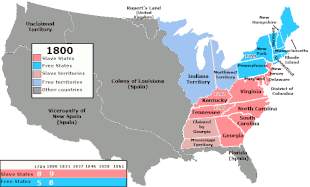
In the early on years of the new United States, a north/due south separate became axiomatic
Slavery was established as a legal institution in each of the Thirteen Colonies, starting from 1619 onwards with the arrival of "twenty and odd" enslaved Africans in Virginia. Although ethnic peoples were also sold into slavery, the vast bulk of the enslaved population consisted of Africans brought to the Americas via the Atlantic slave trade. Due to a lower prevalence of tropical diseases and better handling, the enslaved population in the colonies had a higher life expectancy than in the West Indies and South America, leading to a rapid increase in population in the decades prior to the American Revolution.[ane] [2] Organized political and social movements to cease slavery began in the mid-18th century.[three] The sentiments of the American Revolution and the promise of equality evoked by the Announcement of Independence stood in contrast to the status of most Blacks, either free or enslaved, in the colonies. Despite this, thousands of Blackness Americans fought for the Patriot cause for a combination of reasons. Thousands as well joined the British, encouraged by offers of freedom such every bit the Philipsburg Proclamation.[3]
In the 1770s, enslaved Black people throughout New England began sending petitions to northern legislatures enervating freedom. Five of the Northern self-alleged states adopted policies to at to the lowest degree gradually cancel slavery: Pennsylvania in 1780, New Hampshire and Massachusetts in 1783, and Connecticut and Rhode Island in 1784. The Commonwealth of Vermont had limited slavery in 1777, while it was still independent before information technology joined the U.s. as the 14th state in 1791. These state jurisdictions thus enacted the showtime abolition laws in the Atlantic World.[4] Past 1804 (including New York (1799) and New Jersey (1804)), all of the Northern states had abolished slavery or set up measures in identify to gradually abolish it,[three] [5] although at that place were withal hundreds of ex-slaves working without pay equally indentured servants in Northern states every bit late equally the 1840 demography (see Slavery in the United States#Abolition in the North).
In the South, Kentucky was created a slave state from Virginia (1792), and Tennessee was created a slave state from North Carolina (1796). Past 1804, earlier the creation of new states from the federal western territories, the number of slave and free states was 8 each. Past the time of Missouri Compromise of 1820, the dividing line between the slave and free states was called the Mason-Dixon line (between Maryland and Pennsylvania), with its westward extension existence the Ohio River.
The 1787 Constitutional Convention debated slavery, and for a time slavery was a major impediment to passage of the new constitution. As a compromise, the institution was acknowledged though never mentioned directly in the constitution, as in the instance of the Fugitive Slave Clause. Article 1, Department 9, of the Constitution prohibited Congress from abolishing the importation of slaves, only in a compromise, the prohibition would be lifted in 20 years. The Act Prohibiting Importation of Slaves passed easily in 1807, effective in 1808. Even so, the ban on importation spurred an expansion in the domestic slave merchandise, which remained legal until slavery was banned entirely in 1865 by the 13th Amendment.

The Missouri Compromise of 1820, trading the access of Missouri (a slave state) for Maine (a costless state), drew a line extending westward from Missouri'southward southern edge, which was intended to divide any new territory into slave (southward of the line) and free (north of the line).
In the late 1850s an unsuccessful campaign was launched by several southern states to resume the international slave merchandise, to restock their slave populations, but this met with strong opposition.[6] However, there was large natural increase in the slave population throughout the late eighteenth and nineteenth century, while some illegal smuggling of African slaves connected via Spanish Cuba.
Ane of the other compromises of the Constitution created the three-fifths dominion by which slave states acquired a proportional increase in the House of Representatives and Balloter College equivalent to the size of their disenfranchised slave populations. This increased strength of the southern states was dubbed "slave power" past opponents.
New territories [edit]
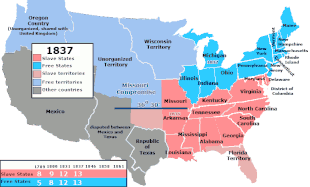
With the statehood of Arkansas in 1836, the number of slave states grew to xiii, but the statehood of Michigan in 1837 maintained the residue betwixt slave and free states.
The Northwest Ordinance of 1787, passed merely before the U.Due south. Constitution was ratified, had prohibited slavery in the federal Northwest Territory. The southern boundary of the territory was the Ohio River, which was regarded as a westward extension of the Bricklayer-Dixon line. The territory was generally settled past New Englanders and American Revolutionary State of war veterans granted land there.[ citation needed ] The 6 states created from the territory were all free states: Ohio (1803), Indiana (1816), Illinois (1818), Michigan (1837), Wisconsin (1848), and Minnesota (1858).[seven]
Past 1815, the momentum for antislavery reform, state by state, appeared to run out of steam, with one-half of the states having already abolished slavery (Northeast), prohibited from the start (Midwest) or committed to eliminating slavery, and half committed to continuing the institution indefinitely (South).
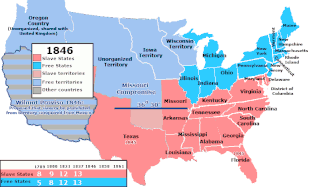
Past 1845, with Texas and Florida in the Union equally slave states, slave states once again outnumbered the free states for a year until Iowa was admitted as a free state in 1846.
The potential for political disharmonize over slavery at a federal level made politicians concerned well-nigh the balance of power in the Senate, where each Country was represented by 2 Senators. With an equal number of slave states and complimentary states, the Senate was every bit divided on bug important to the S. Equally the population of the costless states began to outstrip the population of the slave states, leading to command of the House of Representatives by gratuitous states, the Senate became the preoccupation of slave-land politicians interested in maintaining a congressional veto over federal policy in regard to slavery and other problems important to the Southward. As a issue of this preoccupation, slave states and free states were often admitted into the Spousal relationship in opposite pairs to maintain the existing Senate residuum between slave and free states.
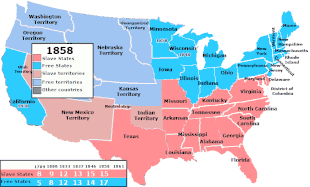
By 1858, 17 free states, which included California (1850), and Minnesota (1858), outnumbered the fifteen slave states.
Missouri Compromise [edit]
Controversy over whether Missouri should be admitted every bit a slave state resulted in the Missouri Compromise of 1821, which specified that territory acquired in the Louisiana Purchase northward of breadth 36° 30', which described most of Missouri'south southern purlieus, would be organized every bit free states and territory s of that line would be reserved for organization every bit slave states. Equally office of the compromise, the admission of Maine (August nineteen, 1821) as a free state was enabled by Missouri's compromise to bring together the union as a slave state (August 19, 1821).[8]
Texas and the Mexican Cession [edit]
The admission of Texas (1845) and the acquisition of the vast new Mexican Cession territories (1848), afterward the Mexican–American War, created further Northward-South disharmonize. Although the settled portion of Texas was an area rich in cotton plantations and dependent on slave labor, the territory acquired in the Mount Due west did not seem hospitable to cotton or slavery.[9]
Equally office of the Compromise of 1850, California was admitted as a costless state without a slave state pair; California's admission also meant at that place would exist no slave land on the Pacific Ocean. To avoid creating a gratis state bulk in the Senate, California agreed to send one pro-slavery and 1 anti-slavery senator to Congress.[10]
Terminal battles [edit]
The difficulty of identifying territory that could exist organized into additional slave states stalled the process of opening the western territories to settlement, while slave-country politicians sought a solution, with efforts being made to acquire Cuba (see: Lopez Expedition and Ostend Manifesto, 1852) and to annex Nicaragua (see: Walker thing, 1856–57), both to be slave states. Parts of Northern Mexico were too coveted, with Senator Albert Brown declaring "I want Tamaulipas, Potosi, and one or ii other Mexican States; and I desire them all for the same reason – for the plantation and spreading of slavery".[11]
Kansas [edit]
In 1854, the Missouri Compromise of 1820 was superseded by the Kansas–Nebraska Deed, which immune white male person settlers in the new territories to determine, by vote (pop sovereignty), whether they would allow slavery within each territory. The issue was that pro- and anti-slavery elements flooded into Kansas with the goal of voting slavery up or down, leading to encarmine fighting.[12] [ total commendation needed ] An endeavour was initiated to organize Kansas for admission as a slave land, paired with Minnesota, but the admission of Kansas equally a slave state was blocked because its proposed pro-slavery constitution (the Lecompton Constitution) had not been approved in an honest election. Anti-slavery proponents during the "Bleeding Kansas" period of the afterward 1850s were called Free-Staters and Free-Soilers, and fought confronting pro-slavery Border Ruffians from Missouri. The animosity escalated throughout the 1850s, culminating in numerous skirmishes and devastation on both sides of the question. Still, the N prevented Kansas Territory from becoming a slave land, and when Southern members of Congress departed en masse in early 1861, Kansas was immediately admitted to the Union equally a complimentary land.
When the admission of Minnesota proceeded unimpeded in 1858, the balance in the Senate ended; this was compounded past the subsequent admission of Oregon equally a free state in 1859.
Slave and free state pairs [edit]
Before 1812, the concern about balancing slave-states and free states was not securely considered. The following tabular array shows the slave and free states as of 1812. The year column is the twelvemonth the land ratified the US Constitution or was admitted to the Union:[xiii]
| Slave states | Year | Gratis states | Year |
|---|---|---|---|
| Delaware | 1787 | New Bailiwick of jersey (Slave until 1804) | 1787 |
| Georgia | 1788 | Pennsylvania | 1787 |
| Maryland | 1788 | Connecticut | 1788 |
| South Carolina | 1788 | Massachusetts | 1788 |
| Virginia | 1788 | New Hampshire | 1788 |
| North Carolina | 1789 | New York (Slave until 1799) | 1788 |
| Kentucky | 1792 | Rhode Isle | 1790 |
| Tennessee | 1796 | Vermont | 1791 |
| Louisiana | 1812 | Ohio | 1803 |

By the eve of the Civil War in mid-1861, with the addition of Oregon (1859) and Kansas (1861), the number of gratis states had grown to xix while the number of slave states remained at xv.
From 1812 through 1850, maintaining the balance of free and slave land votes in the Senate was considered of paramount importance if the Spousal relationship were to be preserved, and states were typically admitted in pairs:
| Slave states | Yr | Gratis states | Year |
|---|---|---|---|
| Mississippi | 1817 | Indiana | 1816 |
| Alabama | 1819 | Illinois | 1818 |
| Missouri | 1821 | Maine | 1820 |
| Arkansas | 1836 | Michigan | 1837 |
| Florida | 1845 | Iowa | 1846 |
| Texas | 1845 | Wisconsin | 1848 |
The balance was maintained until 1850:
| Slave states | Yr | Complimentary states | Year |
|---|---|---|---|
| California | 1850 | ||
| Minnesota | 1858 | ||
| Oregon | 1859 | ||
| Kansas | 1861 |
Ceremonious War [edit]
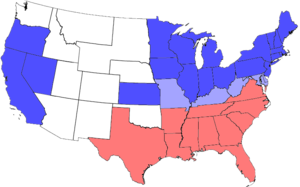
Division of states during the Ceremonious War. Blueish represents Union states, including those admitted during the war; light blue represents border states; cherry-red represents Confederate states. Unshaded areas were not states before or during the Civil War.
The American Civil State of war (1861–1865) disrupted and somewhen concluded slavery. Eleven slave states joined the Confederacy, while the edge states of Delaware, Maryland, Kentucky, and Missouri remained in the Union, despite the presence of slavery within their borders. In 1863 western Virginia, much of which had remained loyal to the Union, was admitted as the new state of Westward Virginia with a commitment to gradual emancipation. The following year Nevada, a costless state in the West, was also admitted.
| Slave state | Year | Gratis state | Year |
|---|---|---|---|
| Westward Virginia (gradual abolition plan) | 1863 | Nevada | 1864 |
Special cases [edit]
West Virginia [edit]
During the Civil War, a Unionist government in Wheeling, Virginia, presented a statehood beak to Congress to create a new state from 48 counties in western Virginia. The new land would eventually comprise 50 counties. The issue of slavery in the new state delayed approval of the bill. In the Senate Charles Sumner objected to the admission of a new slave country, while Benjamin Wade defended statehood equally long as a gradual emancipation clause would be included in the new country constitution.[14] Two senators represented the Unionist Virginia authorities, John Due south. Carlile and Waitman T. Willey. Senator Carlile objected that Congress had no right to impose emancipation on West Virginia, while Willey proposed a compromise amendment to the country constitution for gradual abolitionism. Sumner attempted to add together his ain amendment to the bill, which was defeated, and the statehood bill passed both houses of Congress with the addition of what became known as the Willey Amendment. President Lincoln signed the pecker on Dec 31, 1862. Voters in western Virginia canonical the Willey Amendment on March 26, 1863.[fifteen]
President Lincoln had issued the Emancipation Declaration on January 1, 1863, which exempted from emancipation the border states (four slave states loyal to the Union) as well every bit some territories occupied by Union forces within Confederate states. Two additional counties were added to Westward Virginia in tardily 1863, Berkeley and Jefferson. The slaves in Berkeley were also under exemption but not those in Jefferson County. As of the demography of 1860, the 49 exempted counties held some 6000 slaves over 21 years of age who would not have been emancipated, nigh 40% of the total slave population.[16] The terms of the Willey Amendment just freed children, at birth or every bit they came of age, and prohibited the importation of slaves.[17]
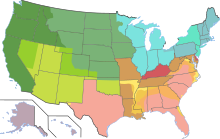
Abolition of slavery in the various states of the US over time:
Abolition of slavery during or shortly after the American Revolution
Gradual emancipation in New York (starting 1799) and New Bailiwick of jersey (starting 1804)
Effective abolition of slavery by Mexican or articulation US/British authority
Exclusion of slavery by Congressional action, 1861
Abolition of slavery by Congressional action, 1862
Subsequent operation of the Emancipation Proclamation in 1863
Abolitionism of slavery by state activity during the Civil War
Operation of the Emancipation Announcement in 1864
Operation of the Emancipation Proclamation in 1865
Territory incorporated into the United states of america after the passage of the Thirteenth Amendment
Due west Virginia became the 35th state on June 20, 1863, and the terminal slave state admitted to the Union.[18] [nineteen] [20] Xviii months subsequently, the West Virginia legislature completely abolished slavery,[21] and as well ratified the 13th Amendment on February 3, 1865.
Washington D.C. [edit]
In the District of Columbia, formed with land from 2 slave states, Maryland and Virginia, the trade was abolished by the Compromise of 1850. And then equally to avoid losing the profitable slave trading businesses in Alexandria (one was Franklin and Armfield), Alexandria County, D.C., requested that it be returned to Virginia, where the slave trade was legal; this took place in 1847. Slavery in the District of Columbia remained legal until 1862, when the walkout of all the Southern legislators permitted those remaining to laissez passer the ban, which abolitionists had been seeking for decades.[ commendation needed ]
Terminate of slavery [edit]
At the offset of the Civil War, there were 34 states in the United states, xv of which were slave states. 11 of these slave states, later conventions devoted to the topic, issued declarations of secession from the United states of america and created the Confederate States of America and were represented in the Confederate Congress.[22] [23] The slave states that stayed in the Union, Maryland, Missouri, Delaware, and Kentucky (called border states) remained seated in the U.S. Congress. By the time the Emancipation Annunciation was issued in 1863, Tennessee was already under Matrimony control. Appropriately, the Proclamation practical only in the 10 remaining Confederate states. During the war, abolition of slavery was required by President Abraham Lincoln for readmission of Confederate states.[24]
The U.S. Congress, later on the departure of the powerful Southern contingent in 1861, was generally abolitionist: In a plan endorsed by Abraham Lincoln, slavery in the District of Columbia, which the Southern contingent had protected, was abolished in 1862.[25]
In southern states, the legal emptying of slavery typically followed Union control. The Emancipation Proclamation declared all enslaved people in areas then under Confederate control gratuitous, but in do, freedom required either slaves reaching Union lines or Union forces reaching their area. As Union forces advanced from Jan 1, 1863 to June xix, 1865 slaves were freed.
Due west Virginia did non cancel slavery in its outset proposed constitution in 1861, though it did ban the importation of slaves from elsewhere.[26] But Radical Republicans refused to admit information technology to the Spousal relationship without putting some limits on the institution. In 1863, voters approved the Willey Subpoena, which provided for gradual abolition of slavery, with the final enslaved people scheduled to exist freed in 1884.[27] On February 3, 1865, the state legislature approved firsthand abolition.[28]
The Restored Government of Virginia — the Unionist government that governed the limited territory then nether Wedlock command which had not left to course Westward Virginia — voted to stop slavery at a constitutional convention on March 10, 1864.[29] Arkansas, part of which came under Wedlock command past 1864, adopted an anti-slavery constitution March 16, 1864.[30] Louisiana — much of which had been nether Matrimony control since 1862 — abolished slavery through a new land constitution approved by voters September v, 1864.[31] The border states of Maryland (November one, 1864)[32] and Missouri (January 11, 1865)[33] abolished slavery before the state of war'due south end. The Union-occupied state of Tennessee abolished slavery by popular vote on a constitutional subpoena which took effect February 22, 1865.[34]
However, slavery legally persisted in Delaware,[35] Kentucky,[36] and (to a very express extent) New Bailiwick of jersey,[37] [38] until the Thirteenth Amendment to the United States Constitution abolished slavery throughout the United States on December 18, 1865, catastrophe the distinction betwixt slave and free states.[39]
Run into too [edit]
- Border states (American Civil War)
- Golden Circle (proposed country)
- Slavery in the colonial The states
- Slavery in the United States
- Wilmot Proviso
References [edit]
- ^ Painter, Nell Irvin. (2006). Creating Black Americans: African-American history and its meanings, 1619 to the present. New York: Oxford University Press. pp. 23–24. ISBN0-xix-513755-8. OCLC 57722517.
- ^ Betty Wood, Slavery in Colonial America, 1619–1776 (2013) extract and text search
- ^ a b c Painter, Nell Irvin (2006). Creating Black Americans: African-American History and Its Meanings, 1619 to the Present . Oxford University Press. pp. 70–72. ISBN978-0195137569.
- ^ Foner, Eric (2010). The Peppery Trial: Abraham Lincoln and American Slavery. New York: West. W. Norton & Visitor, Inc. p. xiv. ISBN978-0-xix-513755-two.
- ^ Wilson, Black Codes (1965), p. 15. "By 1775, inspired past those 'self-evident' truths which were to be expressed past the Declaration of Independence, a considerable number of colonists felt that the time had come to end slavery and give the costless Negroes some fruits of liberty. This sentiment, added to economic considerations, led to the firsthand or gradual abolitionism of slavery in 6 Northern states, while there was a swelling flood of private manumissions in the Due south. Little actual gain was fabricated by the free Negro even in this period, and by the turn of the century the down trend had begun over again. Thereafter the only important modify in that tendency before the Civil War was that afterward 1831 the decline in the status of the complimentary Negro became more than precipitate."
- ^ William W. Freehling. The Road to Disunion, Volume II : Secessionists Triumphant Volume Ii: Secessionists Triumphant, 1854–1861: Secessionists Triumphant Book II: Secessionists Triumphant, 1854–1861. Oxford University Press, 2007. p.168-85
- ^ "LIBERTY! . Northwest Ordinance". PBS . Retrieved July 5, 2020.
- ^ Ken South. Mueller, "Wolf past the Ears: The Missouri Crisis, 1819–1821 by John R. Van Atta." Journal of the Early Republic 37.i (2017): 173–175 online.
- ^ Michael A. Morrison, "Westward the Expletive of Empire: Texas Annexation and the American Whig Party." Journal of the Early Democracy x#2 (1990): 221–249 online
- ^ Michael E. Woods, "The Compromise of 1850 and the Search for a Usable Past." Journal of the Civil War Era 9.iii (2019): 438–456.
- ^ McPherson, James M. Boxing Cry of Freedom: The Civil State of war Era. Oxford University Press, 2003. p.105
- ^ Nicole Etcheson. Bleeding Kansas: Contested Liberty in the Ceremonious War Era (2006). ch i.
- ^ Leonard L. Richards, The Slave Power: The Free N and Southern Domination, 1780—1860 (LSU Printing, 2000).
- ^ James Oakes, Liberty National: The Destruction of Slavery in the U.s.a., 1861–1865, W.W. Norton, 2012, pgs. 296-97
- ^ "Westward Virginians Corroborate the Willey Amendment". wvculture.org . Retrieved December 7, 2015.
- ^ "University of Virginia Library". virginia.edu . Retrieved December vii, 2015.
- ^ "Willey Amendment". wvculture.org. Archived from the original on Baronial fourteen, 2017. Retrieved December seven, 2015.
- ^ Alton Hornsby, Jr.,Black America, A Country-by-State Historical Encyclopedia, Greenwood, 2011, vol. ii, pg. 922
- ^ "West Virginia Statehood". wvculture.org. Archived from the original on March 7, 2007. Retrieved Dec 7, 2015.
- ^ "African-Americans in West Virginia". wvculture.org. Archived from the original on Dec 31, 2013. Retrieved December 7, 2015.
- ^ "On This Day in West Virginia History – February 3". wvculture.org. Archived from the original on October 8, 2014. Retrieved Dec vii, 2015.
- ^ Martis, Kenneth C. (1994). The Historical Atlas of the Congresses of the Confederate States of America, 1861–1865. Simon & Schuster. p. 7. ISBN0-02-920170-v.
- ^ Merely Virginia, Tennessee and Texas held referendums to ratify their Fireman declarations of secession, and Virginia'south excluded Unionist county votes and included Amalgamated troops in Richmond voting as regiments viva voce.Dabney, Virginius. (1983). Virginia: The New Dominion, a History from 1607 to the Present. Doubleday. p. 296. ISBN9780813910154.
- ^ Guelzo, Allen C. (2018). Reconstruction : a concise history. Oxford Academy Printing. p. four. ISBN978-0-19-086569-6. OCLC 999309004.
- ^ American Memory "Abolition in the District of Columbia", Today in History, Library of Congress, viewed Dec xv, 2014. On April xvi, 1862, Lincoln signed a Congressional act abolishing slavery in the Commune of Columbia with bounty for slave owners, 5 months before the victory at Antietam led to the Emancipation Announcement.
- ^ Lewis, Virgil Anson (1889). History of West Virginia: in two parts. pp. 379–380. Retrieved Nov 24, 2021.
- ^ West Virginia Legislature (March 15, 2021). "House Concurrent Resolution 49". Retrieved November 24, 2021.
- ^ "The Abolition of Slavery in Virginia". Retrieved November 21, 2021.
- ^ "Education from LVA: Convention Resolved to Abolish Slavery". edu.lva.virginia.gov. Archived from the original on March thirty, 2016.
- ^ "Freedmen and Southern Society Project: Chronology of Emancipation". www.freedmen.umd.edu. University of Maryland. Retrieved November 26, 2019.
- ^ "Reconstruction: A Land Divided".
- ^ "Archives of Maryland Historical Listing: Constitutional Convention, 1864". November 1, 1864. Retrieved Nov xviii, 2012.
- ^ "Missouri abolishes slavery". January 11, 1865. Archived from the original on April 25, 2012. Retrieved November eighteen, 2012.
- ^ Us. Congress. Articulation Committee on Reconstruction; Us. Congress (1866). Report of the Articulation Commission on Reconstruction, at the First Session, Thirty-ninth Congress: Resolutions, committees, etc. U.South. Government Printing Office. pp. 10–. ISBN978-0-598-67518-7. OCLC 17596217.
- ^ "Slavery in Delaware". Slavenorth.com . Retrieved Jan 21, 2017.
- ^ Harrison, Lowell H.; Klotter, James C. (1997). A New History of Kentucky. Lexington, Ky.: University Press of Kentucky. p. 180. ISBN0813126215 . Retrieved October sixteen, 2016.
- ^ "Slavery in the Eye States (NJ, NY, PA)". Encyclopedia.com. July xvi, 2020. Retrieved June 19, 2020.
- ^ Smith, Geneva. "Legislating Slavery in New Jersey". Princeton & Slavery . Retrieved June nineteen, 2020.
- ^ Kocher, Greg (Feb 23, 2013). "Kentucky supported Lincoln's efforts to abolish slavery — 111 years belatedly | Lexington Herald-Leader". Kentucky.com. Archived from the original on July 2, 2018. Retrieved January 21, 2017.
Farther reading [edit]
- Don Due east. Fehrenbacher and Ward Grand. Mcafee; The Slaveholding Republic: An Account of the United States Regime's Relations to Slavery (2002)
- Rodriguez, Junius P. Slavery in the United States: A social, political, and historical encyclopedia (two vol Abc-clio, 2007).
External links [edit]
- Slavery in the North
Source: https://en.wikipedia.org/wiki/Slave_states_and_free_states
0 Response to "What Was the Last State to Abolish Slavery"
Postar um comentário